SEO and Backlinks: What Actually Works and What Will Burn You
In the world of SEO and Backlinks, few ranking factors generate as much debate link building strategies and their impact on search results.
While the landscape has evolved significantly, especially in 2025's AI-driven search environment, the fundamental truth remains: backlinks are links from other websites pointing to your site, and they continue to be important for SEO when acquired through legitimate, editorial means.
This VERY VERY comprehensive guide (which is curated and written after monitoring more than 300 real questions asked by real users on Reddit) tries to provide policy-grounded strategies backed by Google's official documentation and real SERP data.
The value of a backlink isn't determined by arbitrary metrics like Domain Authority (that you get from Moz or other platforms); it's about relevance, context, types of backlinks, number of backlinks, and whether the link was earned naturally.
As we navigate the post-AIO landscape where both traditional search and AI overviews matter, understanding how to build backlinks properly has never been more critical for your overall SEO strategy.
So, let's discover what is the role of backlinks in SEO in the post-AIO era!
First Principles: What Google Still Uses Links For (and What It Ignores)
Understanding PageRank vs. Manipulative Links
PageRank continues to operate as a fundamental ranking factor in Google's algorithm, but its implementation has evolved far beyond simple link counting.
According to Google's spam policies, link spam includes "buying or selling links for ranking purposes" and "excessive link exchanges".
The search engine distinguishes between natural editorial backlinks and manipulative schemes through sophisticated pattern detection.
Contrary to popular belief, "indexing services" that promise to make garbage backlinks count are ineffective.
Google's systems evaluate link quality through multiple signals: the linking page's indexation status, its traffic patterns, topical relevance, and the context surrounding the link.
A backlink from an unindexed page or a page with no real traffic passes minimal to no value, regardless of what any SEO tool might indicate about its "authority."
Reference: Google for Developers - Spam Policies
Quality Over Quantity: The Data Behind Effective Link Building
Analysis of top-ranking pages reveals a consistent pattern:
Sites ranking in positions 1-3 typically have between 35-85 unique referring domains, with the median hovering around 50.
However, pages with 10 high-quality backlinks from relevant, authoritative sources consistently outperform those with 100+ links from low-quality directories or unrelated sites.
The correlation between unique referring domains and organic traffic shows diminishing returns after approximately 40-50 quality backlinks.
This suggests that once you've established a strong backlink profile with diverse, relevant sources, additional low-quality links provide negligible benefit.
Focus your link-building efforts on earning backlinks from sites within your industry or closely related niches and see the impact on your search engine ranking!
When to Use Rel Attributes: Staying Compliant While Building Links
Google requires specific rel attributes for different link types:
- rel="sponsored" for paid placements
- rel="ugc" for user-generated content
- rel="nofollow" for links you don't want to endorse.
Understanding when and how to use these attributes is crucial for maintaining compliance while still benefiting from your link-building strategies.
For sponsored content or any form of compensated placement (including product exchanges or comped services), you must use rel="sponsored".
Guest post links where you've paid for placement or provided value in exchange require this attribute. The rel="ugc" attribute applies to links in comments, forums, and other user-generated areas.
Standard editorial backlinks that you've earned through quality content require no special attributes.
Reference: Google for Developers - Qualify Outbound Links
2) What's Risky/Manipulative vs. Safe/Editorial in Backlinks for SEO
Paid Links & Link Rentals (Including "Niche Edits")
Google's position on paid links is unambiguous: "Buying or selling links for ranking purposes" violates their guidelines unless properly marked with rel="sponsored".
This includes traditional paid placements, "niche edits", where you pay to insert links into existing content, and monthly link rental schemes.
The search engine's detection capabilities have evolved to identify patterns associated with paid link networks.
These patterns include sudden link velocity changes, footprints in anchor text distribution, and network-level signals when multiple sites participate in the same schemes.
Calling paid placements "PR" or "partnerships" doesn't change their nature; if money or goods exchange hands for a link, it requires proper attribution.
To stay compliant when engaging in legitimate paid partnerships, always mark links with rel="sponsored" and focus on placements that provide value beyond SEO.
Quality sponsored content that reaches your target audience can be beneficial for SEO even with the rel attribute, as it drives brand awareness and potential natural linking.
References: Google for Developers - Link Spam, Google Search Central Blog on Spam Updates
Mass Guest Posts / Marketplaces / Fiverr Bundles
The era of mass guest posting for link building is effectively over.
Google specifically identifies "articles, guest posts, or press releases distributed on other sites" with optimized anchor text as link spam.
Marketplaces selling "10 guest posts for $500" or Fiverr bundles promising "50 high DA backlinks" create obvious footprints that Google's algorithms detect.
These schemes fail because they generate predictable patterns:
- Similar author bios across multiple sites
- Identical pitch templates
- Clusters of links appearing simultaneously,
- Content that adds no unique value.
When dozens of sites suddenly publish similar guest posts with links to your site, it triggers algorithmic suppression or manual review.
Safe guest posting still exists, but requires a different approach.
Focus on contributing genuinely valuable content to publications your audience actually reads. Write for humans first, include links only when they add value to readers, and limit yourself to 1-2 high-quality guest posts per month on relevant, established platforms.
Reference: Google for Developers - Link Schemes
Directories & Citations (Local SEO)
While mass directory submission died years ago, a select few directories still provide value, particularly for local SEO.
Google My Business, Yelp, industry-specific directories, and local Chamber of Commerce sites can boost local search visibility when they match your NAP (Name, Address, Phone) information consistently.
The key differentiator is whether real humans use these directories to find businesses.
A directory that sends actual referral traffic and maintains editorial standards provides value.
The "submit to 1000 directories" services create worthless backlinks that Google ignores.
Focus on 10-15 high-quality, relevant directories rather than hundreds of automated submissions. For local businesses, prioritize directories that your customers actually use:
Professional associations, local business groups, industry-specific platforms, and regional directories with genuine readership.
These often have lower "authority scores" but provide stronger local relevance signals.
Google Stacking / Public Doc Farms
"Google Stacking" refers to creating multiple Google properties (Docs, Sites, Forms) filled with links pointing to your site.
Despite claims from some SEO practitioners, this technique provides minimal value and can appear manipulative.
Google evaluates content quality regardless of the platform, and low-quality content designed primarily to manipulate rankings violates their guidelines.
These properties typically lack genuine user engagement, original content, or editorial oversight. While a legitimate Google Doc or Site with valuable content might pass some link value, farms of thin documents created solely for backlinking purposes are easily identified and discounted by Google's algorithms.
Reference: Google for Developers - Scaled Content Abuse
Swaps, Exchanges & Roundups: Navigating the Gray Areas of SEO Strategy
1:1 Swaps and Excessive Link Exchanges
Google explicitly lists "excessive link exchanges" and "partner pages exclusively for the sake of cross-linking" as link spam.
While occasional reciprocal linking between genuinely related sites is natural, systematic link swapping triggers algorithmic penalties.
The threshold for "excessive" typically emerges when more than 20-30% of your backlink profile consists of reciprocal links, or when you engage in regular swap agreements.
Google's algorithms detect these patterns through temporal analysis (links appearing simultaneously), network analysis (clusters of sites all linking to each other), and content relevance scoring.
Safer alternatives include: co-creating valuable resources that naturally warrant mutual citation, participating in legitimate industry partnerships where links are incidental to the relationship, and focusing on earning one-way editorial links through superior content.
Reference: Google for Developers - Link Schemes
3-Way and 4-Way Exchange Networks
Triangular linking schemes (Site A → Site B → Site C → Site A) might seem clever, but Google's network analysis capabilities are even cleverer and detect these patterns!
These arrangements fall under "link schemes" as they're designed primarily to manipulate PageRank.
These networks often emerge from "link building clubs" or private groups where members coordinate linking strategies.
The footprints are obvious: clusters of sites with similar link velocity, overlapping anchor text patterns, and minimal topical relevance between linked sites.
Instead of participating in exchange networks, focus on genuine content collaboration.
Co-authored research, legitimate partnership announcements, and industry reports that naturally reference multiple sources provide value without triggering spam filters.
Reference: Google for Developers - Link Spam Policies
Expert Roundups in 2025 (and probably, 2026)
Expert roundups remain viable when executed properly, but the reciprocity expectation has become problematic.
The typical "I'll feature you if you share/link" arrangement can trigger exchange penalties when overdone.
Modern roundups must prioritize genuine expertise and reader value over link-building.
Successful roundups in 2025 focus on:
- Featuring recognized experts without link requirements
- Adding substantial analysis beyond quote collection
- Creating interactive or multimedia content that encourages natural sharing
- Following up with participants without demanding links.
When participating in roundups, contribute unique insights rather than recycled talking points. Link to the roundup only if you would genuinely share it with your audience, regardless of your inclusion.
HARO / Qwoted / Journalist Requests
Help a Reporter Out (HARO) and similar platforms still provide value, but the signal-to-noise ratio has degraded.
Journalists receive hundreds of pitches for each query, and many "opportunities" come from low-quality sites fishing for content.
- Focus on queries that match your expertise exactly.
- Provide quotable, specific insights backed by data or unique experience.
- Verify the publication's legitimacy before investing time in detailed responses.
Quality responses to relevant queries from established publications beat mass pitching to every vaguely related opportunity.
How Many Backlinks Do We Need? Data-Driven Target Setting
Estimating Link Demand by SERP Analysis
Rather than chasing arbitrary metrics, analyze your specific SERP to understand the competitive landscape. Here's a real-world example for different query types:
For a Commercial Query: "project management software"
- Position 1: around 130 referring domains
- Position 2: around 90 referring domains
- Position 3: around 95 referring domains
Target range: 75-100 quality referring domains
For an Informational Query: "How to manage remote teams"
- Position 1: around 45 referring domains
- Position 2: around 30 referring domains
- Position 3: around 30 referring domains
Target range: 25-35 quality referring domains
For a Local Query: "plumber denver"
- Position 1: around 20 referring domains
- Position 2: around 20 referring domains
- Position 3: around 15 referring domains
Target range: 15-25 local/relevant referring domains
This data reveals that link demands vary dramatically by intent and competition level.
Tools can help you gather this data, but focus on referring domains from indexed, traffic-generating pages rather than raw link counts.
Reference: Manual SERP analysis using a backlink industry tool
Backlinks on Homepage vs. Internal Pages Strategy
Distributing backlinks strategically across your site architecture maximizes their impact.
Your homepage typically attracts the most natural backlinks, but commercial and informational pages often need direct link-building support.
For new sites, concentrate initial efforts on building homepage authority through brand mentions and partnerships.
Once established, shift focus to directly supporting money pages and cornerstone content.
Internal linking from your strong pages can then distribute authority throughout your site.
The ideal distribution for most sites:
- 40% to homepage/brand
- 30% to main commercial pages
- 20% to cornerstone content/resources
- 10% to supporting blog posts
This creates a natural-looking backlink profile while supporting pages that drive conversions.
Distributing Limited Budget: The 100-Link Thought Experiment
Imagine you have the resources to acquire 100 quality backlinks. Here's an optimal distribution strategy:
For E-commerce Sites:
- 30 links to homepage (brand building)
- 25 links to top category pages
- 20 links to cornerstone buying guides
- 15 links to product comparison pages
- 10 links to seasonal/campaign landing pages
For SaaS Companies:
- 35 links to homepage
- 25 links to main product pages
- 20 links to comparison/alternative pages
- 10 links to integration pages
- 10 links to educational resources
For Local Service Businesses:
- 40 links to homepage
- 30 links to main service pages
- 20 links to service area pages
- 10 links to case studies/portfolio
This distribution ensures no single page appears over-optimized while building topical authority across your site.
Local Businesses: Why Low Authority Links Often Win?
For local SEO, a backlink from your local Chamber of Commerce (e.g, DA 25) typically outweighs a link from a national lifestyle blog (e.g, DA 80).
Geographic and topical relevance wins against generic authority metrics for local search.
Prioritize these local link sources:
- Local news sites and blogs
- Community organizations and charities
- Local business associations
- Supplier and vendor websites
- Customer testimonial pages
- Local event sponsorships
- Community partnership pages.
These backlinks work because they establish genuine local connections that Google's local algorithm values.
A plumber in Denver benefits more from five links from Denver-based sites than from fifty links from national directories.
Indexing & Why Your Backlinks Don't Show or Count?
Google's Selective Indexing and Quality Gates
Not every page on the internet gets indexed, and links from unindexed pages provide no SEO value.
Google applies quality thresholds before indexing pages, considering factors like content uniqueness, page structure, site authority, and crawl budget allocation.
Even when pages are indexed, not all links count equally.
Links from pages with thin content, excessive outbound links, or no organic traffic pass minimal value.
Google's quality gates filter out links from:
- pages with no real user engagement
- automatically generated pages
- pages blocked by robots.txt
- pages with hundreds of outbound links.
Check if linking pages are indexed using site: searches or URL inspection in Google Search Console.
If important backlinks come from unindexed pages, work with the site owner to improve the page quality rather than abandoning the link opportunity.
Reference: Google's general crawling and indexing documentation
The Truth About Backlink Indexing Tools
Services promising to "index your backlinks faster" typically ping search engines or create temporary links to your backlinks.
These tactics don't convert bad links into good signals; they merely attempt to accelerate the discovery of links that would eventually be found anyway.
Google's crawling priorities are based on:
- site authority and freshness signals
- internal and external link signals
- sitemap submissions and Search Console data
- content quality and user engagement metrics
Forcing discovery through artificial means doesn't improve link quality or impact.
Save your money and focus on acquiring backlinks from regularly crawled, indexed pages with genuine traffic. These links get discovered naturally and carry actual ranking value.
Reference: Google for Developers - How Google Search Works
Indexing API Myths and Realities
Google's Indexing API is explicitly limited to JobPosting and BroadcastEvent structured data.
Despite claims from some SEO tools, you cannot use the Indexing API to force indexation of pages containing your backlinks.
Attempting to misuse the Indexing API for general content can result in:
- API access revocation
- ignored submission requests
- potential algorithmic suppression
- wasted development resources
Focus on legitimate indexation methods:
- submitting updated sitemaps
- using URL inspection in Search Console
- improving content quality and user engagement
- building internal links to important pages
Reference: Google for Developers - Indexing API
Pre-Qualifying Links Before You Chase Them
Before pursuing any link opportunity, run this qualification check:
- Is the page indexed? (site:URL search)
- Does it receive organic traffic? (check for ranking keywords)
- Is it topically relevant? (manual review)
- What's the outbound link count? (under 50 is ideal)
- Is the placement editorial? (within content vs. sidebar/footer)
A link that fails multiple criteria isn't worth pursuing, regardless of the site's domain authority. Focus your outreach on opportunities that pass at least 4 of 5 criteria.
Pricing & ROI: Understanding What Backlinks Important For?
What You're Actually Paying For (of course, IF you pay)
If you engage in paid partnerships or sponsored content, you're paying for audience access, brand exposure, and content creation, not just the link.
Remember that paid links must use rel="sponsored" to comply with Google's guidelines.
Legitimate sponsored opportunities provide access to a relevant, engaged audience, brand mention in quality editorial content, potential referral traffic, social media amplification, and relationship building with publishers.
Price should reflect these factors, not arbitrary metrics.
A sponsored post on a niche industry blog with 5,000 engaged monthly readers often provides better value than placement on a high "DR" site with no relevant audience.
Reference: Google for Developers - Link Spam Guidelines
Red Flags in Link Building Offers
Avoid services exhibiting these warning signs:
- Guaranteed placement promises: "50 DR70+ guaranteed placements" indicates a network vulnerable to penalties.
- Identical author bios: The same writer bio appearing across dozens of sites reveals a content farm.
- Zero topical relevance: Fashion blogs linking to B2B software suggest paid networks.
- No editorial standards: Sites accepting any content regardless of quality or relevance.
- Bulk pricing: "$5 per link" or "1000 links for $500" guarantees low quality.
- Private blog networks (PBNs): Sites existing solely to provide backlinks get devalued or penalized.
- Budget Models: Local vs. SaaS Companies
Local Business Budget Allocation:
- Community sponsorships: $500-2000/month
- Local media relationships: $300-1000/month
- Professional associations: $100-500/month
- Content creation for partners: $500-1500/month
- Total: $1,400-5,000/month for 5-15 quality local links
SaaS Company Budget Allocation:
- Industry publication features: $2000-5000/month
- Integration partnership content: $1000-3000/month
- Developer community engagement: $500-1500/month
- Data studies and research: $2000-4000/month
- Conference and event sponsorships: $1000-5000/month
- Total: $6,500-18,500/month for 10-25 quality industry links
These budgets assume proper rel="sponsored" attribution where required and focus on valuable placements beyond just link acquisition.
Mentions vs. Links in the AI Era
Brand mentions without links have gained importance in the AI/LLM era, but for Google ranking, following contextual links remains the stronger signal.
Mentions help with:
- brand entity recognition
- potential inclusion in AI overviews
- reputation signals
- future link opportunities
However, Google's ranking systems primarily use links to understand page relationships and authority. Prioritize acquiring actual links while accepting that mentions provide complementary value.
The optimal approach:
Pursue opportunities that provide both links and mentions, ensure consistent brand name usage across mentions, and build relationships that might convert mentions to links later.
Reference: Google for Developers - How Search Works
7) Special Cases of SEO and Backlinks Redditors Asked About
Footer "Built By" Links for Agencies
Credit links in website footers occupy a gray area.
While Google doesn't explicitly prohibit them, keyword-stuffed footer links or manipulative sitewide patterns violate guidelines.
Best practices for footer credits:
- Use branded anchor text ("Designed by [Agency Name]")
- Consider using rel="nofollow" if contractually required
- Avoid keyword-rich anchors ("SEO Services Miami")
- Limit to one link per client site
- Ensure the link adds genuine value (potential clients might click)
These links provide minimal SEO value but can drive qualified referral traffic and build brand awareness.
Hyper-Local Strategies for Lawyers, Therapists, and Trades
Professional service providers need different link-building strategies than e-commerce or SaaS companies. Each group should focus on different priorities:
For Lawyers:
- Local bar association profiles
- Legal aid organization partnerships
- Local university law clinic collaborations
- Court website attorney directories
- Verdict and settlement news coverage
For Therapists:
- Professional association directories (e.g., APA, NASW, etc)
- Hospital and clinic partnerships
- Mental health nonprofit relationships
- University counseling center referrals
- Insurance provider directories
For Tradespeople:
- Supplier and manufacturer certifications
- Better Business Bureau profiles
- Trade association memberships
- Project showcase on material supplier sites
- Local home improvement show participation
These industry-specific opportunities provide relevant, local backlinks that support both SEO and business development.
Starting from Zero: Link Building for New Sites (DR 2-10)
New sites with minimal authority need a foundation-first approach. Start with these accessible link types:
- Vendor/Supplier Links: Every business relationship is a link opportunity
- Customer Case Studies: Feature clients and earn reciprocal links
- Local Business Profiles: Chamber, BBB, professional associations
- Industry Tool Creation: Simple calculators or resources that earn natural links
- Founder Interviews: Podcast appearances and local media features
- Partnership Announcements: Press releases about genuine collaborations
- Community Involvement: Sponsorships and volunteer work coverage
- Alumni Networks: University and previous employer connections
- Industry Forum Participation: Valuable contributions, not spam
- Original Research: Even small studies attract editorial links
Target 10-20 quality backlinks in your first six months rather than chasing quantity. Each link should come from a real relationship or value exchange.
International and Low-Competition Markets
In markets with limited existing resources, create what's missing:
Become the Resource:
- Create the first comprehensive industry directory in your language
- Develop bilingual guides bridging local and international best practices
- Build tools specific to local regulations or needs
- Partner with universities to publish student research
Local Partnership Strategies:
- Collaborate with government agencies on digital initiatives
- Support local startup ecosystems
- Create educational content for business associations
- Develop resources for tourism boards
These markets often have less competition but also fewer obvious link opportunities. By creating foundational resources, you can attract backlinks while genuinely serving your market.
8) Safe Process: Building a Strong Backlink Profile Without Footprints
Prospecting Rubric for Link Opportunities
Evaluate every potential backlink against these criteria:
Relevance (Weight: 40%)
- Direct topical overlap with your content
- Audience alignment with your target market
- Natural fit for your brand mention
Traffic (Weight: 25%)
- Organic search visibility for relevant keywords
- Consistent referral traffic potential
- Active user engagement (comments, shares)
Indexation (Weight: 20%)
- Page is indexed in Google
- Site has consistent crawling patterns
- No manual actions or penalties
Outbound Link Quality (Weight: 10%)
- Links to authoritative, relevant sources
- No obvious paid link patterns
- Less than 50 external links per page
Editorial Standards (Weight: 5%)
- Clear author bylines and bios
- Editorial review process is evident
- Original, valuable content
Score each factor 1-5 and weight accordingly. Pursue only opportunities scoring 3.5 or higher.
Anchor Text Distribution for Natural Link Profiles
Avoid exact-match repetition across domains by following this distribution:
- Branded anchors (40-50%): "YourBrand," "YourBrand.com"
- Naked URLs (15-20%): "https://yourbrand.com"
- Generic anchors (15-20%): "click here," "this article," "learn more"
- Partial match (10-15%): "quality backlink strategies," "SEO services from YourBrand"
- Exact match (5-10%): Your target keywords (use sparingly)
- Image alt text (5%): When linking through images
This distribution mimics natural linking patterns and avoids algorithmic penalties for over-optimization.
Tracking and Cleanup Strategies
Monitor your backlink profile monthly using:
Google Search Console:
- Review the "Links" report for new backlinks
- Check for sitewide links or unusual patterns
- Monitor anchor text distribution
Third-Party Tools:
- Track new and lost links
- Identify potentially toxic backlinks
- Monitor competitor link acquisition
Cleanup Actions: Only use the disavow tool for manual actions or clearly toxic legacy links. Most low-quality links can be ignored as Google discounts them automatically.
Reference: Google Help - Disavow Links
Velocity and Cadence for Natural Growth
Natural link acquisition follows predictable patterns tied to your content and PR calendar:
Sustainable Velocity Guidelines:
- New sites: 3-5 quality links per month
- Established sites: 10-20 quality links per month
- During campaigns: 2-3x normal velocity for 2-4 weeks
- Post-campaign: Return to baseline within 30 days
Sudden spikes from marketplace purchases or network schemes trigger algorithmic reviews. Time your outreach to coincide with content launches, product releases, or PR campaigns for natural-looking growth patterns.
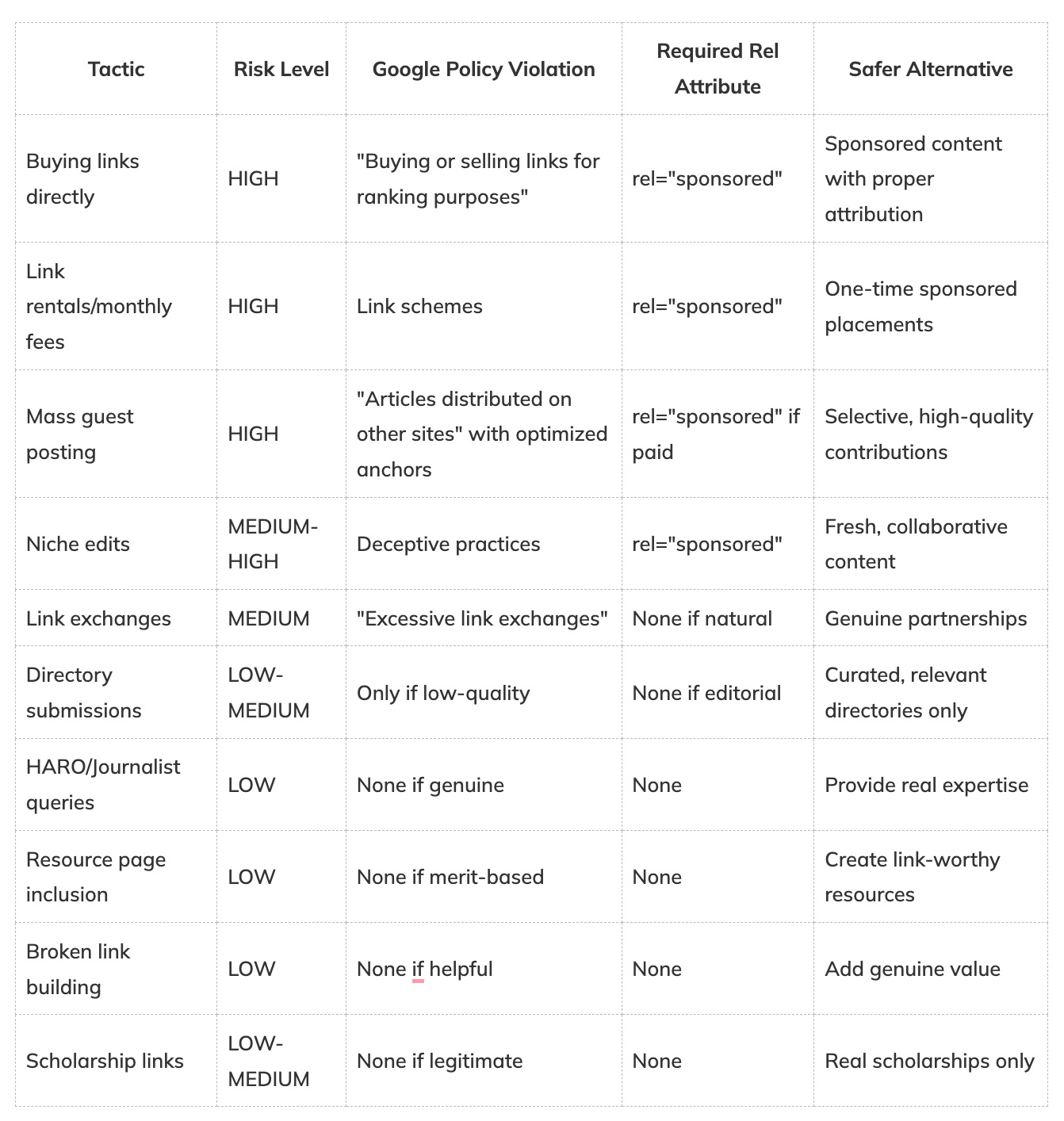
Risk Matrix: Link Building Tactics Mapped to Google Policies
Checklists for Safe Link Building
Prospecting Checklist
- The site is indexed in Google
- Pages have organic search traffic
- Content is topically relevant
- Author pages exist with real bios
- Outbound links go to quality sites
- No obvious link selling signals
- Real audience engagement is visible
- Editorial guidelines posted
- Contact information available
- Site has been active for 12+ months
Safe Anchor Mix Checklist
- No more than 5% exact match anchors
- 40-50% branded/URL anchors
- Vary anchor text across domains
- Use natural, conversational phrases
- Include generic anchors ("click here")
- Match anchors to context
- Avoid keyword stuffing
- Use image links occasionally
- Monitor distribution monthly
- Adjust based on competition
Velocity/Cadence Checklist
- Link growth matches content calendar
- No sudden unexplained spikes
- Campaign bursts under 3x baseline
- Return to normal within 30 days
- Consistent month-to-month pattern
- New links from diverse sources
- Mix of followed/nofollowed links
- Natural day-of-week distribution
- Seasonal patterns make sense
- Growth proportional to site size
Swap-Avoidance Patterns
- Less than 20% reciprocal links
- No systematic exchange agreements
- Links separated by 30+ days
- Different anchor text patterns
- Genuine content collaboration
- Natural co-citation context
- No private exchange networks
- Avoid triangular schemes
- Document legitimate partnerships
- Focus on one-way links
What NOT to Do: Direct Policy Violations
According to Google's spam policies, these practices explicitly violate guidelines:
- Buying or selling links for ranking purposes
- Exchanging money for links, or posts that contain links
- Excessive link exchanges or partner pages exclusively for cross-linking
- Using automated programs or services to create links
- Requiring a link as part of the Terms of Service without allowing qualification
- Text advertisements that pass ranking credit
- Low-quality directory or bookmark site links
- Keyword-rich, hidden, or low-quality links embedded in widgets
- Widely distributed links in footers or templates
- Forum comments with optimized links
Source: Google for Developers - Spam Policies
2025-2026 Playbook: Tactics That Still Move Rankings
Editorial Link Earning Strategies
- Original Research and Data Studies: Create industry-specific research that becomes citable
- Interactive Tools and Calculators: Build resources people naturally link to
- Expert Commentary: Become a go-to source for journalist queries
- Partnership Content: Collaborate with complementary brands
- Digital PR Campaigns: Create newsworthy stories that earn coverage
Proper Sponsored Attribution
When engaging in paid partnerships:
- Always use rel="sponsored" for compensated placements
- Include disclosure language in content
- Focus on audience value, not just links
- Document all paid relationships
- Avoid networks promising "natural" paid links
KPI Ladder for Link Building Success
- Discovery Metrics
- New referring domains detected
- Links indexed vs. discovered ratio
- "Time to discovery" average
- Authority Metrics
- Domain authority growth (directional only)
- Page authority increases
- Trust flow improvements
- Visibility Metrics
- Keyword ranking improvements
- SERP visibility percentage
- Featured snippet captures
- Traffic Metrics
- Organic traffic growth
- Referral traffic from links
- Brand search increases
- Business Metrics
- Assisted conversions from organic
- Revenue attribution to SEO
- ROI on link-building investment
Mini-Workflow: Link Qualification Process
Step 1: Confirm Page Indexation
- Run site:URL search in Google
- Check Google Cache date
- Verify in Search Console if accessible
- Decision: If not indexed → Ignore opportunity
Step 2: Assess Traffic and Engagement
- Check for ranking keywords using SEO tools
- Look for social shares and comments
- Verify publication frequency
- Decision: If no traffic/engagement → Low priority
Step 3: Evaluate Topical Relevance
- Read surrounding content
- Check site's main topics
- Assess audience overlap
- Decision: If irrelevant → Skip opportunity
Step 4: Analyze Link Context
- Count outbound links on page
- Check link placement (in-content vs. sidebar)
- Review anchor text diversity
- Decision: If over-optimized → Avoid
Step 5: Make Pursuit Decision
- Score all factors (1-5 scale)
- Weight by importance
- Pursue: Score > 3.5
- Maybe: Score 2.5-3.5
- Ignore: Score < 2.5
Tool Comparison Table
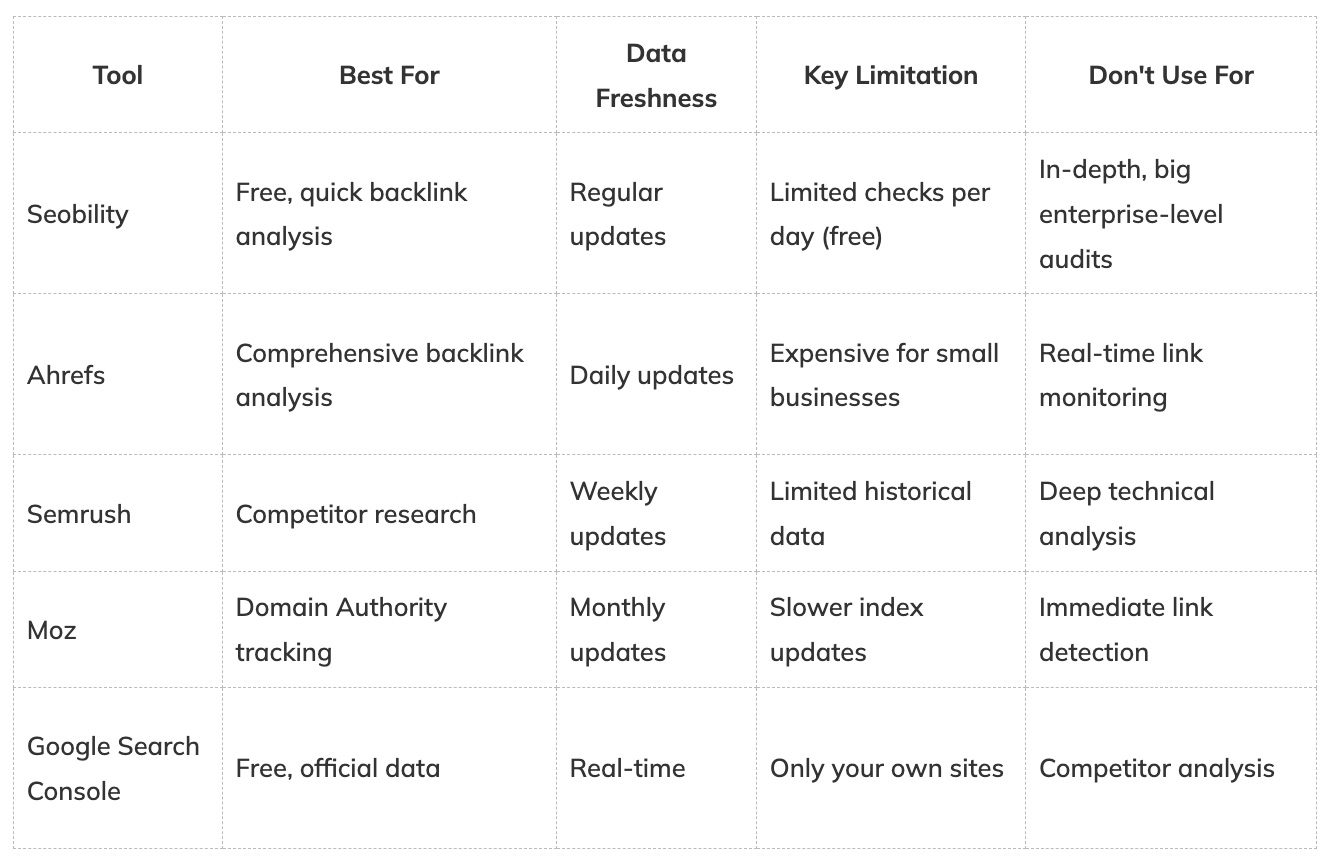
Critical Note: Don't chase every link you see in competitor profiles. Many are irrelevant, outdated, or impossible to replicate. Focus on patterns and opportunities you can genuinely earn.
Compliance Guide: Sponsored Content Requirements
When Placement is Paid and How to Mark Sponsored?
Any exchange of value requires rel="sponsored":
- Direct payment for links
- Product provided for review
- Service comped for coverage
- Affiliate commission potential
- Barter/trade arrangements
- Event tickets or travel
- Exclusive access provided
This is how you can mark the link as a sponsored one.
<a href="https://example.com" rel="sponsored">Link</a>
- Add rel="sponsored" to all compensated links
- Include disclosure text in content
- Don't try to hide sponsorship
- Apply consistently across campaigns
- Document all paid relationships
Footprint Risk Assessment
Repeated Exact-Match Anchors
High Risk Patterns:
- Same anchor text across 10+ domains
- Keyword-rich anchors exceeding 10%
- Unnatural commercial anchor density
Safe Practices:
- Vary anchors even for the same target page
- Use branded and generic anchors primarily
- Let publishers choose natural anchors
Mass Marketplace Patterns
Detection Signals:
- Multiple links appearing same week
- Similar content templates across sites
- Identical author bios on different domains
- Common IP addresses or hosts
- Same outreach templates
Avoidance Strategies:
- Spread link acquisition over time
- Create unique content for each placement
- Work with individual publishers
- Avoid link marketplace platforms
- Customize every outreach message
Diversification Tactics
- Source Diversity: Mix publishers, blogs, news, resources
- Geography: Include local, national, and international sources
- Authority Levels: Combine high and medium authority sites
- Content Types: Articles, resources, tools, mentions
- Link Types: Editorial, bio, resource, citation
- Timing: Natural, irregular acquisition patterns
Metric Reality Box
DA/DR/AS ≠ Ranking Factor
Important Truth: Domain Authority, Domain Rating, and Authority Score are third-party metrics, not Google ranking factors.
What These Metrics Actually Measure:
- Third-party tool calculations
- Relative link popularity
- Competitive benchmarking aids
- Directional indicators only
How to Use Them Properly:
- Initial Triage: Quick filtering of obviously weak sites
- Relative Comparison: Understanding competitive gaps
- Trend Tracking: Monitoring your own progress
- Never Decisive: Always verify with real factors
What Really Matters for Link Value:
- Relevance: Topical and audience alignment
- Indexation: Page must be indexed
- Traffic: Real visitors indicate value
- Link Context: Placement within valuable content
- Editorial Nature: Genuine recommendation vs. paid
Decision Framework:
- DA 20 site in your exact niche > DA 80 general news site
- 10 referral visitors > 100 DA points
- Relevant context > High metrics
- Real editorial link > Any paid placement
Decision Tree: When Niche Relevance Beats Domain Metrics
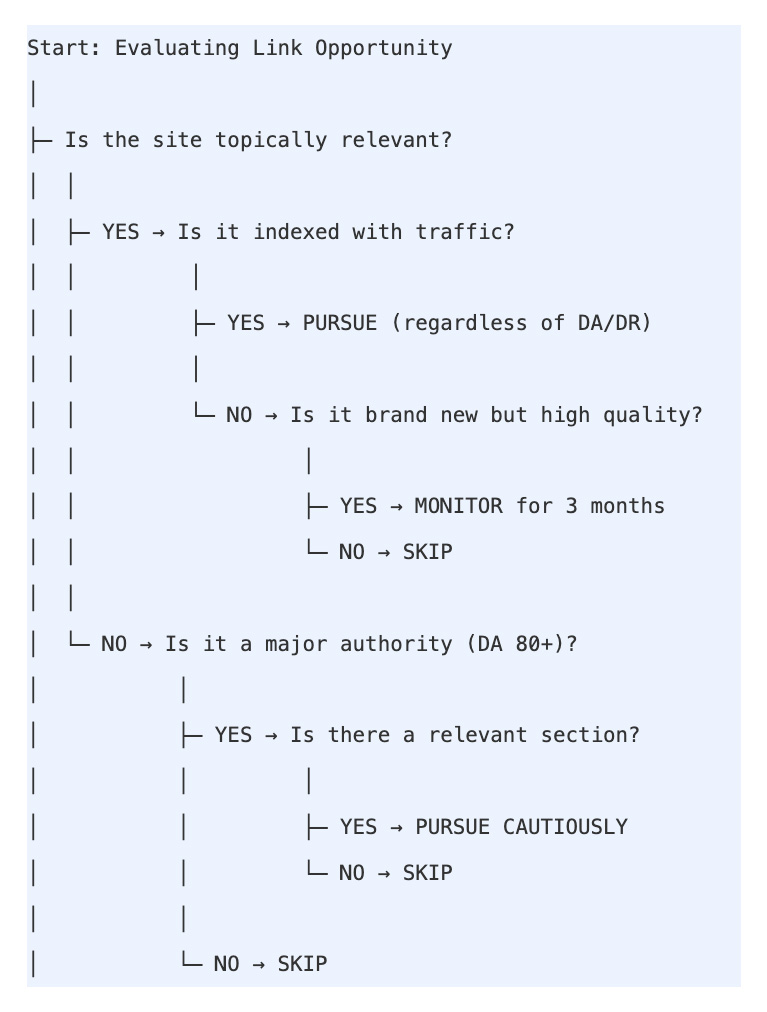
Example Scenarios:
Scenario 1: Local Denver plumbing blog (DA 20)
- Highly relevant to a Denver plumber
- 500 local monthly visitors
- Decision: PURSUE - Perfect local relevance
Scenario 2: Major lifestyle magazine (DA 85)
- No plumbing content
- 1M monthly visitors
- Decision: SKIP - No topical relevance
Scenario 3: National home improvement site (DA 65)
- Has a plumbing section
- 100K monthly visitors
- Decision: PURSUE - Good balance of relevance and authority
How-To Steps: Building Your First 10 Quality Backlinks
Step 1: Create Your Link-Worthy Asset
- Input: Research, expertise, or data
- Process: Develop a comprehensive guide, tool, or study that provides unique value
- Output: Published resource that naturally attracts links
- Pitfall: Avoid thin, me-too content that adds nothing new
Step 2: Identify Your Direct Competitors
- Input: Your main keywords
- Process: Search your keywords and note the top 5 competitors
- Output: List of competitor domains to analyze
- Pitfall: Don't include sites you can't realistically compete with (Wikipedia, Amazon, etc.)
Step 3: Analyze Competitor Backlink Profiles
- Input: Competitor domains
- Process: Use tools to find their best backlinks
- Output: List of 50-100 potential link targets
- Pitfall: Don't chase every link; focus on replicable ones
Step 4: Qualify Link Opportunities
- Input: List of potential targets
- Process: Run through the qualification checklist
- Output: Prioritized list of 20-30 opportunities
- Pitfall: Avoid sites with obvious paid link signals
Step 5: Craft Personalized Outreach
- Input: Target site and contact information
- Process: Write a customized email showing value
- Output: Sent outreach with a clear value proposition
- Pitfall: Never use mass templates or automation
Step 6: Provide Immediate Value
- Input: Positive response to outreach
- Process: Deliver exceptional content or resource
- Output: Published content with a natural link
- Pitfall: Don't be pushy about exact anchor text
Step 7: Build the Relationship
- Input: Successful placement
- Process: Thank them, share their content, stay connected
- Output: Long-term publishing relationship
- Pitfall: Don't immediately ask for another link
Step 8: Monitor and Document
- Input: New backlink acquired
- Process: Track in a spreadsheet with all details
- Output: Complete record of link acquisition
- Pitfall: Don't forget to check if the link stays live
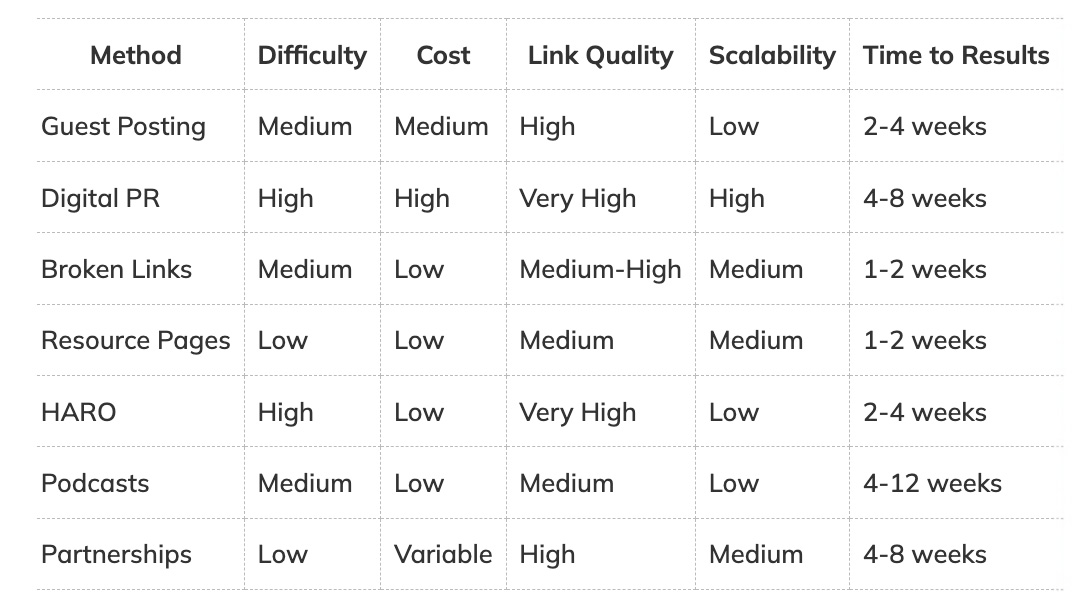
Comparisons of Different Link Building Methods
Guest Posting vs. Digital PR
Guest Posting:
- Pros: Direct control, predictable results, relationship building
- Cons: Time-intensive, doesn't scale well, quality varies
- Cost: $500-2000 per high-quality placement
- Best for: Niche expertise demonstration
Digital PR:
- Pros: Scalable, high-authority links, brand building
- Cons: Less control, requires newsworthy angles, and competitive
- Cost: $3000-10,000 per campaign
- Best for: Brands with unique stories or data
Broken Link Building vs. Resource Page Outreach
Broken Link Building:
- Pros: Provides clear value, higher success rate
- Cons: Time to find opportunities, competitive
- Cost: Time investment mainly
- Best for: Sites with comprehensive resources
Resource Page Outreach:
- Pros: Straightforward process, clear intent pages
- Cons: Highly competitive, lower response rates
- Cost: Time investment mainly
- Best for: Truly exceptional resources
Comparison Matrix
Implementation: Templates and Tools
Outreach Email Template
Subject: Question about [specific article/resource]
Hi [Name],
I just finished reading your article on [specific topic] and particularly appreciated your point about [specific detail showing you actually read it].
I recently published a [description of your resource] that expands on [relevant point from their article]. It covers [unique angle/data not found elsewhere].
If you think it would add value for your readers, I'd be honored if you'd consider including it as a resource in your article. Here's the link: [URL]
Either way, thanks for the great content. I've bookmarked your site and look forward to reading more.
Best,
[Your name]
[Your credentials if impressive]
FAQ about SEO and Backlinks effect
Q1: Do nofollow backlinks help SEO at all?
While nofollow links don't pass traditional PageRank, they can still drive referral traffic, build brand awareness, and contribute to a natural backlink profile. Google has stated that they treat nofollow as a "hint" rather than a directive, meaning some value may still pass through high-quality nofollow links.
Q2: How many backlinks do I need to rank?
There's no magic number. Analysis of SERPs shows top-ranking pages have anywhere from 15 to 1000+ referring domains, depending on the query competitiveness. Focus on earning more quality backlinks than your direct competitors, rather than hitting an arbitrary target.
Q3: Should I disavow bad backlinks?
Google recommends using the disavow tool only for manual actions or when you know of toxic backlinks from previous SEO efforts. Google's algorithms generally ignore low-quality links automatically, so disavowing is rarely necessary for most sites.
Q4: Are backlinks from social media valuable?
Most social media links are nofollow and provide minimal direct SEO value. However, social shares can amplify content reach, leading to editorial links from people who discover your content through social channels.
Q5: How long before I see results from link building?
Typically, it takes 10-16 weeks to see meaningful ranking improvements from new backlinks. The timeline depends on your site's existing authority, the quality of acquired links, and competitive factors in your niche.